
If you are sourcing tables and chairs for events, hospitality, or rental operations, you will quickly realize that what you buy matters—but when you buy often matters even more.Price is always a factor, but production lead time, shipping duration, and peak-season order pressure are usually what determine whether your project arrives on time or gets delayed. Even when you choose the right products, poor timing can still lead to late delivery or unexpected extra costs.So the real question is- when is the right time to place your order, and how should different buyers plan their purchasing schedule?

Why Timing Matters in Wholesale Furniture Purchasing
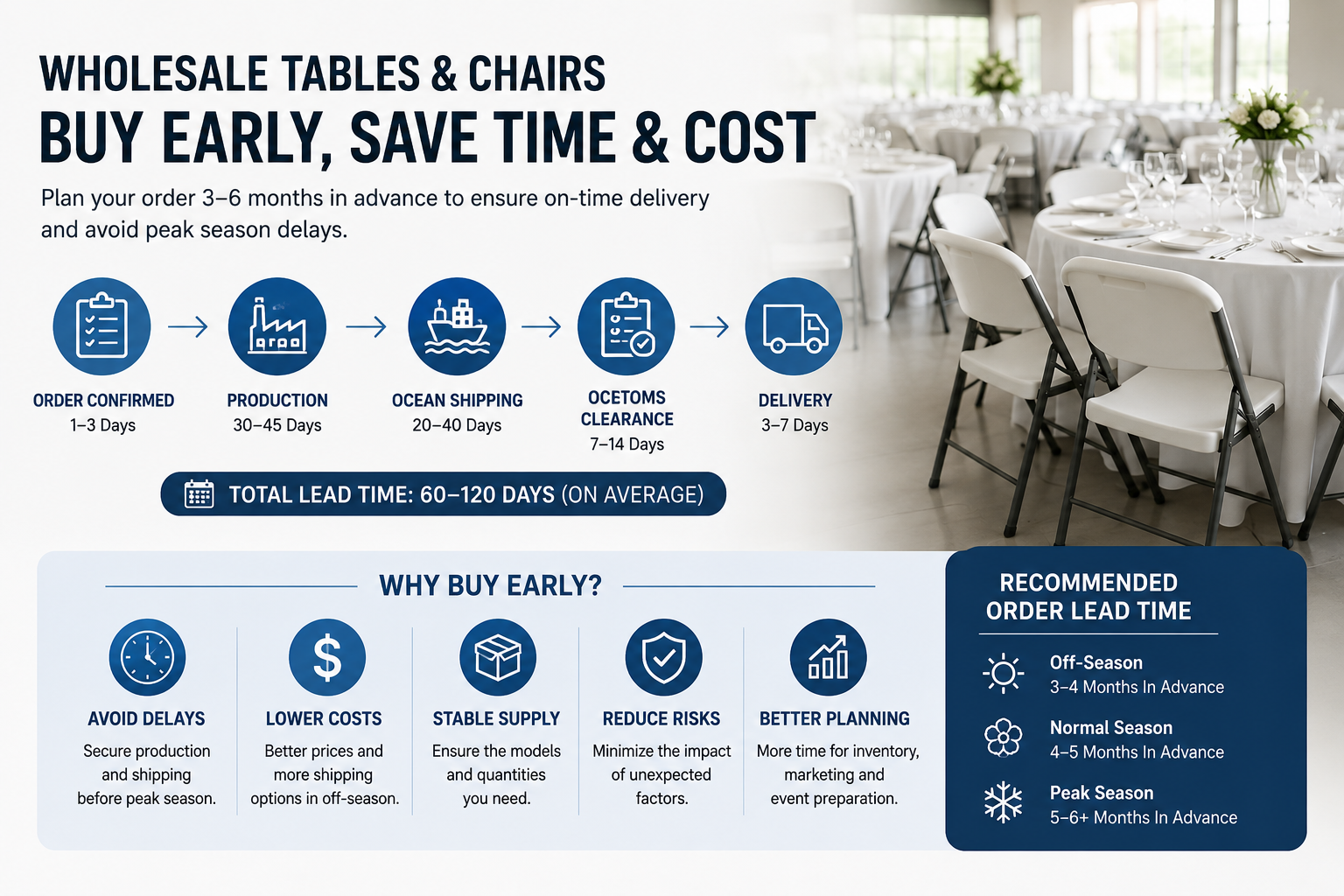
Once you start buying tables and chairs in bulk, timing becomes one of the easiest things to misjudge.From the moment you place an order to the final delivery, the process is made up of several stages—production scheduling, quality inspection, ocean freight, and customs clearance. None of these steps are instant, and during peak seasons, each stage can take longer than expected.Because of this, delays rarely happen because the product is wrong. More often, it’s because the order was placed too late.
How Different Industries Should Plan Their Purchasing Timeline
Different businesses operate on very different cycles. Some deal with seasonal demand spikes, while others are driven by project timelines or internal budgeting. That’s why there is no single “best time” that fits everyone—you need to plan based on how your business actually operates.
Event Rental Company
If you run an event rental business, your demand is highly seasonal. Wedding season, graduation season, and holiday events often create sudden spikes in orders.Experienced rental operators usually prepare inventory before peak season begins, rather than waiting for orders to arrive. Once demand surges, both production and logistics tend to slow down, making it harder to restock quickly.In this business, you are not reacting to demand—you are preparing for it.
Wedding Venue & Wedding Planner
The wedding industry is unique: orders may come in gradually, but execution tends to cluster within specific time periods.You might secure bookings months in advance, but actual setup schedules often fall within the same season. If you purchase furniture on a per-event basis, you may quickly run into timing conflicts and operational pressure during peak months.
Hotels & Banquet Centers
For hotels, purchasing decisions are usually not driven by urgency, but by internal processes.Renovations, banquet hall upgrades, or annual budget approvals typically trigger procurement. In many cases, timing depends more on approval cycles than market demand.If you miss a budget window, you may have to wait until the next financial cycle before placing new orders.
Schools & Educational Institutions
School procurement follows a very structured calendar, typically aligned with academic terms.Most purchases happen during holiday breaks or between semesters, since this is the only period that does not disrupt normal operations.Missing this window often means waiting for the next break, which naturally extends the project timeline.
Furniture Distributors
For distributors, the focus is not a single project but inventory turnover.You need to balance changing market demand with storage capacity and cash flow. Instead of large one-time purchases, many distributors prefer phased replenishment to maintain flexibility and reduce inventory risk.
How Long Does Wholesale Ordering Take?
In most cases, bulk furniture orders are not completed immediately after placement.You need to consider the full supply chain cycle, including production, quality control, shipping, and customs clearance.On average, the entire process takes around 60 to 120 days.If customization is required—such as color options, branding, or packaging—the timeline may be even longer.That’s why a more practical approach is to plan your purchase at least 3 to 6 months in advance, instead of waiting until the last minute.
Signs It’s Time to Restock or Replace Furniture
You don’t always need a fixed timeline to decide when to purchase. In many cases, your business operations will already give you clear signals.For example, if you frequently run out of stock during peak periods and need emergency replacements, it usually means your current inventory is no longer sufficient.If your furniture shows visible wear that affects customer experience, it’s no longer just maintenance—it becomes a replacement decision.Similarly, if your business is expanding or you are taking on larger projects, your existing setup may no longer match your operational needs.Another key indicator is rising maintenance costs. When repair expenses approach the cost of new purchases, replacement is often the more efficient option.
Common Mistakes in Bulk Purchasing
In practice, most procurement issues are not caused by the products themselves, but by how purchasing decisions are made.One of the most common mistakes is focusing only on unit price while ignoring total landed cost, including shipping, storage, and lifecycle usage.Another frequent issue is underestimating lead time. During peak seasons or logistics congestion, production and shipping schedules can easily extend beyond expectations, leading to delays.Some buyers also wait until inventory is nearly depleted before reordering, which puts unnecessary pressure on the supply chain.Others fail to account for business growth, resulting in repeated stock shortages shortly after replenishment.
How to Build a Smarter Purchasing Plan
A well-structured purchasing plan should not start with “what to buy today,” but rather with future demand forecasting.You should first map out your business activity for the next 6 to 12 months, including expected event volume and project timelines.Then, break down the supply chain into production and logistics phases to calculate the latest possible ordering date.It’s also important to build in buffer time for unexpected delays such as shipping congestion or seasonal peak production.In many cases, purchasing during off-peak periods can significantly improve both cost efficiency and delivery stability.Ultimately, a strong procurement strategy is about balancing cost, timing, and risk.
Why Choosing a Reliable Supplier Matters
Even with perfect timing, an unreliable supplier can still disrupt your entire plan.In bulk procurement, a supplier’s role goes far beyond product supply. It directly affects how predictable your delivery process will be.Experienced suppliers are able to manage production schedules more efficiently during peak seasons and reduce bottlenecks in manufacturing.They also understand international logistics better, allowing for more efficient container loading and lower shipping costs.More importantly, a stable supplier reduces uncertainty across sampling, communication, and quality control, making your procurement process far more predictable.In short, choosing a supplier is not just a pricing decision—it defines the stability of your entire supply chain.
Conclusion
Buying wholesale tables and chairs is never just a purchasing decision—it is a supply chain strategy that directly impacts project execution.When you buy, how you plan inventory, and who you choose to work with all determine whether your operations run smoothly or face unexpected disruptions.By treating procurement as part of your long-term business planning rather than a last-minute task, you can better control costs, reduce risk, and improve delivery reliability.Companies like Ai-Cathlon support this process by combining stable manufacturing capacity with export experience, helping buyers plan their procurement cycles more effectively and build a more predictable supply chain.
FAQ
1. When is the best time to buy wholesale tables and chairs?
Most buyers start planning 3–6 months before their project to avoid peak season delays and shipping congestion.
2. How long does wholesale furniture take to deliver?
Typically, production and shipping take around 60–120 days depending on order size and customization.
3. Why should I buy tables and chairs in advance?
Because manufacturing and logistics require time, and late orders often lead to delays or higher costs during peak seasons.
4. Can I place urgent bulk orders?
Yes, but urgent orders usually come with limited options and higher risk of delays, especially during busy seasons.
5. What factors affect wholesale furniture lead time?
Production schedule, customization, shipping method, and seasonal demand all affect delivery time.